
How to Structure STEM Activities for Preschoolers

Share

Preschoolers are learners within elementary age(0-4years old) and they are considered natural-born scientists eager to channel their curiosity to feel their environment. As a parent or tutor, you can leverage this by structuring STEM activities for preschoolers that does not require complex setup.
By prioritising a suitable play-based STEM learning approach for your kids, you have turned their everyday routine into moments for building skills that ensures fast-thinking and solving problems.
What is a Structured STEM Activity for Preschoolers?
Structured STEM activity for preschoolers are play-based experiences that serves as guides for early learners through science, technology, engineering, or math concepts using a framework appropriate for their age. Unlike regular play, structured early STEM activities feature a clear learning path with teacher’s guidance and hands-on problem-solving materials designed to build the young ones cognitive foundations.
Key Takeaways
-
Curiosity drives Learning
Naturally, four-year-olds are curious. You can tap into this and set up physical boundaries that guide them through basic scientific procedures.
-
Play-based Focus proves Helpful
For preschoolers, play is work. So keeping STEM activities embedded in open-minded activities ensures intrinsic motivation and eradicates fear of failure.
-
The 3-Part Session Learning
Your structured framework for kids must run through; the hook & question, the play laboratory, and reflection circle. These three pillars are a successful guide to every child learning because they turn abstract concepts into sensory real-world experience.
-
Integrate Simple Home STEM Models
Setting up a STEM home model does not require much work. You can start with simple projects such as buoyancy tests using kitchen sink and gravitate towards others with time.
The Natural Curiosity of Preschoolers
Due to the fact that preschoolers still don’t have a clear view of how the world operates, their innate curiosity drives them to test boundaries, constantly observe objects, and ask “why” schedules are done in a certain way to get a perfect view of how things should be done.
As a guardian, you can build on this curiosity by creating an easy home STEM project that improves the young learner’s mind. The academic approach does not have to be rigid at first. Instead, it should involve hands-on exploration.
This is because at that tender age, the preschoolers can not comprehend formulas but can align with physical phenomena such as watching an object floating on water. By framing STEM activities around the under four-year old curiosity, you can playfully guide them through scientific approaches such as; hypothesis, testing, and discovery.
Keep Learning Play-Based
For a four-year old, play serves as their work. So you are expected to structure learning activities around their natural drive without exploring rigid or pre-determined outcomes.
This way, they can learn basic science such as; physics and chemistry by stacking blocks and mixing water & mud. When you embed hands-on science for preschoolers into play, they gain intrinsic motivation to try new things without fear of being wrong.
The activities around the above principles remains why children can easily assimilate under guided and open minded exploration rather than strict lesson plans. It is a considerable reason why young learners appear to master concepts faster because they have the privilege of trial, error, and joyful discovery.
Guide to Building a Successful Four-years Old Class Session
Building a successful play-based STEM learning session for a preschooler requires transforming your lesson plan into a discovery framework. The reason is that, at this stage, they are considered to be at developmental phase.
So, the kids’ learning should be around interactive challenges that ensure collaborative problem solving. You can structure the activity into the below 3 active sequence;
-
The Hook & Question(5-10 minutes)
Keep it simple. First, gather your child(ren) to the centre of learning and introduce the question. It can be; “What material should we use to build a house for our little sheeps?”
-
The Play Laboratory(20-23 minutes)
Following the earlier question, provide hands-on materials such as blocks, straw, and playdough to open their mind to building. As a guardian, your role is to instruct and ask intriguing questions such as; “what will happen if we add A and B together?”
-
The Reflection Circle(3-10 minutes)
This stage is more about reflection, clean up, and discovery. You are expected to focus on the process rather than what didn’t work. When it comes to easy home STEM projects, perfect results are not usually gotten at first trial. So, allow the children to grow with time.
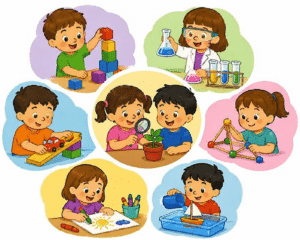
Just as archeologists carefully uncover history, structured preschool STEM activities allow children to systematically discover scientific concepts.
What is Preschool Engineering in Early Childhood STEM?
Preschool engineering is a refined path that allows children to design, build, test, and modify open-ended materials on their own. In a structured STEM environment, this process involves hands-on tasks such as; stabilizing a block tower or routing a water pipe meant to teach them foundational spatial awareness, trial-and-error reasoning, and basic physics principles through play method.
The Simple Pillars of Hands-On Science for Preschoolers
The hands-on science for preschoolers are exploration, experimentation, and observation. For a child, involving in abstract subjects isn’t just about memorization. It is based on active and sensory experience.
As a guardian, allow young learners explore, manipulate, touch and sort real- world objects. This way, you can always ask themselves the “what if” questions, and test their ideas.
It is simply an invitation to encourage them to take action while you observe changes and track results. By adopting the above principle for STEM activities for preschoolers, you have turned abstract subjects into simplified challenges.
Instead of carrying a lesson note with a diagram of a plant, you can structure activities that involve digging, planting, and measuring seed daily growth for the kids’ better understanding.
At the end, your academic guide must align to the four-years old natural learning cycle to ensure that the provision of physical objects prompt scientific discovery through playful approach.
What is the Inquiry-Based Structure in Early STEM?
Inquiry-based STEM structure involves building an educational framework that organises children lessons around their natural curiosity. Instead of providing answers, the class teacher devise a structure that prompts exploration, data collection, and reflection. It is simple a process of turning a basic classroom project into an investigative session.
Easy Home STEM Projects to Try Today
STEM activities at home do not require much capital or specialised tools. It is all about transforming your everyday household items into hands-on science for preschoolers. The best home projects invite physical testing and are structured around ensuring young learner’s curiosity. Here are two STEM projects you can try at home today;
-
The Kitchen Sink Buoyancy Test
Block the kitchen sink and fill it with water. Then, gather random items such as; spoon, coin, or plastic toys. Ask your child to drop each object in the water and proceed with “What will happen when the item drops in?” This is you introducing the concepts of density and floating.
-
Paper Cup Architecture
Hand the preschooler a few sheets of cardboard and paper cups. Then challenge them to build anything such as; bridge or tower. This way, you introduce the basics of structural engineering and prompt their mind to be creative.
As earlier mentioned, the initial stages might appear difficult. However, this home STEM activities for preschoolers is far better than rigid instructional classroom manuals.
Read: Somatic Resets: Overcoming Complex Learning Gridlocks
Conclusion
Structuring STEM activities for preschoolers is all about channeling their natural curiosity into purposeful discovery. It is not the usual classroom sessions of rigid formulas and complex frameworks.
By creating an interactive session where children can daily explore their environment. You have built a play-based STEM learning foundational background where young ones can joyfully fail, question, test ideas as they inculcate a lifelong learning habit.
Ready to transform your early childhood classroom? Explore our Easy home STEM projects today to unlock step-by-step activity guides and lesson plans that make science fun and effortless for your preschoolers.