How to Spot the “Illusion of Competence” Before Exam Day

Share
There is a false confidence students always have after relying on passive re-reading habits when preparing for exams. This illusion of competence study provides an idea of mastery of the entire material.
However, the critical gap gets exposed on exam day when you appear like a complete novice. To not experience this, the below explains how to spot hidden comprehension weaknesses early and approach to replace them with active concept mastery.
Please note that if you make a purchase or sign up through links on this post, we may earn a small commission at no extra cost to you.
Read: Andragogy vs. Pedagogy: How to Fix Adult Learner Lock Up Under Pressure
Key Takeaways
Recognition not equal Recall
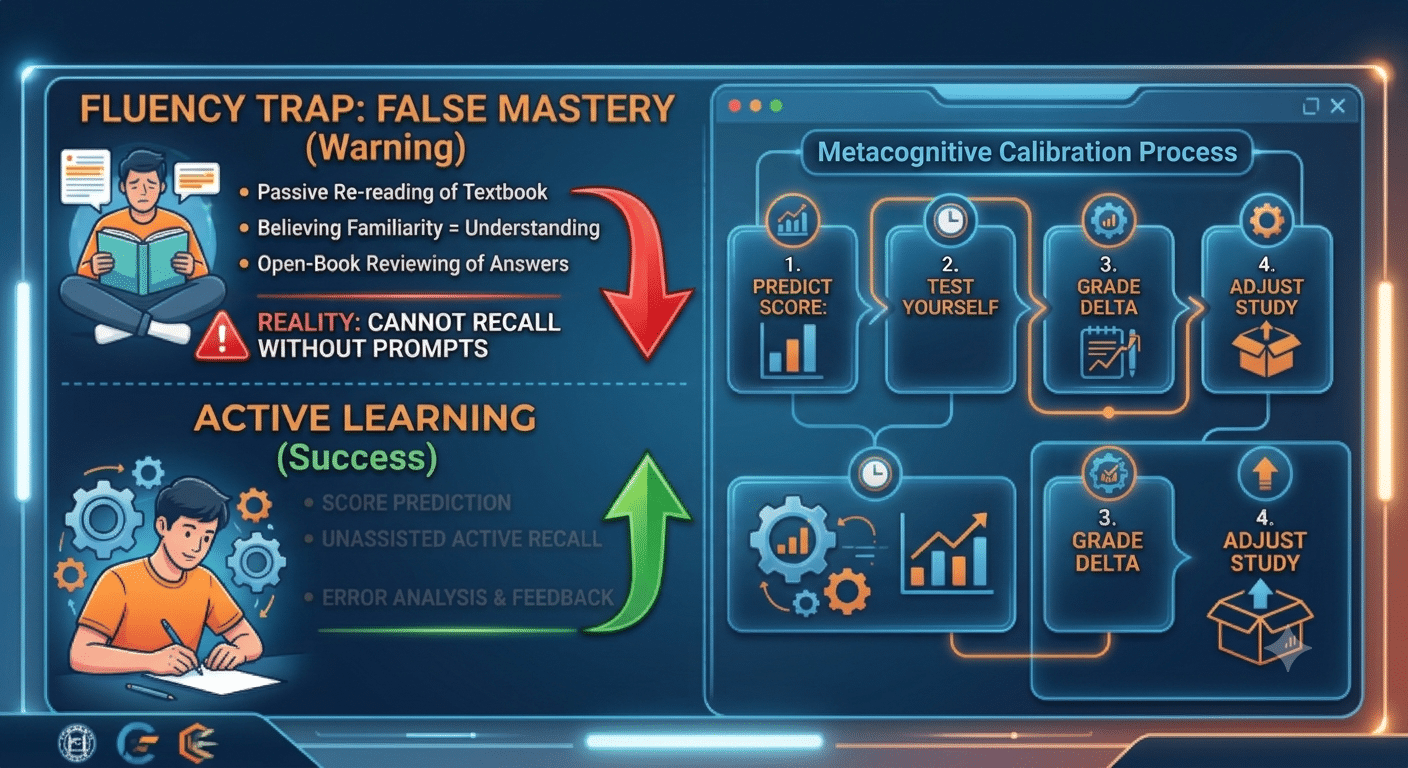
Reading and highlighting topics for a long time creates a fluency trap. While perusing familiar concepts feels harmless, visual recognition does not equal active memory retrieval during exams.
Spot the Warning Signs Early
Signs such as; overestimating your test preparedness, freezing when asked a question, relying on only highlighted phrases and assuming you know a concept are all illusions of competence.
Implement Metacognitive Calibration
To align your confidence with actual results, adopt the three calibration protocols. These steps include; predicting score before test, answering questions under closed book, and comparing test result with predicted score.
Run a Pre-Exam Readiness Audit
You can verify your exam readiness using active checklists such as; unassisted retrieval, predictive accuracy, feynman technique, and timed practice.
Read: Somatic Resets: Overcoming Complex Learning Gridlocks
Defining the Threat
The illusion of competence study exposes a dangerous cognitive bias that confuses subject familiarity with true mastery. During reading hours where notes are taken and textbooks get highlighted, going through the same material over time makes it feel recognizable.
However, this is a false sense of preparation as you might not be able to recall key concepts when required. This is why you see students spend hours preparing for a paper but on the d-day, they fumble.
A critical learning gap has occurred because their memory can not retrieve stored information. To fix this, learn how to measure study readiness accurately. Real examination readiness isn’t about spending hours reviewing solutions. It is about actively self-testing what you have learnt under strict conditions before the main day.
The “I Know This” Delusion
The “I know this” delusion is about looking at a concept and believing an immediate wave of familiarity signifies mastery. It is a classic illusion of competence study where you convince yourself of having enough knowledge just by glancing at an answer.
The truth is, human brains always recognize information that is familiar. But many students do not understand that this awareness has zero effect on active knowledge retrieval causing freezing on exam day.
If your concern is how comfortable you are with a topic, a critical step of understanding how to measure study readiness has been missed. You have to look beyond the false sense of security to get a real preparedness solution.
An excellent approach to measuring comprehension is independent reproduction of learnt concepts and providing answers to quiz under exam-like conditions.
Signs You Are Suffering from False Competence
Recognizing the signs of false exam competence early is an excellent approach to effective quiz preparation. The biggest challenge is usually the contrast between fluency trap vs active recall where going through learning material for a long time feels effortless providing a false sense of true subject mastery.
To not fall short, the primary signs that passive review is misleading your exam readiness are;
-
Mixing Familiarity with Retrieval
A simple approach to falling into this category is having a sense of fully quiz preparedness but freezing when asked to explain a concept you claimed to study.
-
Being too Quick to Check Answers
When asked a question, do not mistake passive recognition for active memory retrieval. Expunge the attitude of checking answers early believing you already know it.
-
Depending on Only Highlighted Words
While highlighted words show you have identified key concepts, overdependence on it could create an illusion of progress. Always scan through each text to build deep long-term retention.
-
Overconfidence
Consistently rating your understanding high during review leads to overconfidence. When there is a mock test, an unexpected score drop only shows poor metacognitive calibration techniques.
Metacognitive Calibration Techniques to Test Yourself
By using metacognitive calibration techniques to self evaluate, you simply bridge the existing gap between perceived comprehension and actual performance. In simpler words, calibration checks whether your self-assessed confidence matches your quiz scores.
Similarly, testing yourself helps ensure that you do not fall into the fluency trap vs active recall conflict where smooth reading and note taking feels effortless. This way, the brain can not be tricked to mistake visual familiarity for true mastery.
The below is a metacognitive calibration practical step to test yourself;
-
Score Prediction
Before attempting the mock test, self assess and write down your expected score.
-
Closed-Book Active Recall
Treat the mock test like a strict exam and answer questions without notes, answer keys, or hints.
-
Error Analysis & Calibration Delta
Grade your result and compare your work to the earlier expected score.
If your score is low and confidence appears high, know that the critical blind spot was identified and can be dismantled using routine metacognitive calibration techniques. Using this approach ensures that you systematically shift away from fluency trap vs active recall illusion into active retrieval practices that show exam readiness.

Before diving into intensive revision, measure your study readiness by assessing your focus level, emotional baseline, and cognitive clarity
Checklist to Measure Study Readiness for Exam
To avoid the illusion of competence study, don’t rely on passive review where spending hours studying only builds familiarity. Choose only approaches that ensure what you read sticks to your brain. To determine whether you are well prepared for exam or not, use the below checklist to evaluate yourself;
-
Unassisted Retrieval
Ask yourself, if given a sheet of paper now, can you recall the core concepts without checking notes?
-
Condition-Similated Practice
Despite dealing with mock questions, it must be practiced under strict exam conditions to get the best output.
-
Predictive Accuracy
Does your expected score before practice match or exceed the actual grade. The given result determines whether the test becomes routine or not.
-
Feynman Technique
Feynman Technique involves using your own words to explain the complex concept. It is the simplification of a topic into plain language every beginner understands.
By asking yourself the above questions, your focus shifts from passive to active output. Understanding how to measure study readiness involves a rigorous approach to bridging knowledge gaps before exam day.
Read: Beyond Feynman: The Somatic Hack to Learn 2x Faster Without Burnout
Conclusion
Honest self-testing is the first step to overcoming the illusion of competence. While re-reading leads to text familiarity, it does not guarantee success on exam day. So, implement metacognitive calibration techniques today to address hidden blind spots, evaluate what you have learned, and improve self-confidence before stepping into that exam centre.