
Andragogy vs Pedagogy: 5 Key Differences Every Educator Must Know

Share
When adult learners are treated like traditional students, the result is fast track disengagement. Understanding andragogy vs pedagogy in higher education is the best approach to driving real orientation.
The reason is because while pedagogy relies on the teacher-student instructional model, matured candidates’ learning involves self-taught approach with practical application and mutual respect.
Please note that if you make a purchase or sign up through link on this post, we may earn a small commission at no extra cost to you
Read: 5 Core Principles that Fast-Track Adult Comprehension
Key Takeaway
-
Target Motivation
Matured learners are generally driven by internal motivators such as; solving immediate problems, career growth and self improvement whereas younger ones rely on grades, parent/teacher approval, and diploma.
-
Instructor Shift
For successful learning experience, educators must transition from being an authority figure to a facilitator ready to support self-direct comprehension.
-
Role of Experience
Andragogy treats candidates as a rich reservoir with enough knowledge that can be built upon. While pedagogy treats younger ones as a blank slate with no prior experience.
-
Problem-Focused vs Subject-Focused
Traditional learning wants students to master/cram subjects for future application. In contrast, andragogy centers on real life experience and practical usage.
-
Online Design Strategy
In andragogical environment, courses are flexible, self-paced modules with peer-to-peer feedback loops. The pedagogy approach is quite different.
Explaining Malcolm Knowles’ Adult Learning Theory Summary
Malcom Knowles revolutionized modern education by introducing techniques that shift learning from teacher-led to student-centre design. He was able to achieve this result using five core assumptions of self-directed growth.
The idea behind his principles is that adult comprehension best occurs when a new idea is built on an existing rich reservoir of life experience over cramming abstract concepts. Malcom’s educational approach prioritises real-life application and internal motivation.
When using his model to differentiate between andragogy vs pedagogy in higher education, university instructional materials must be structured around problem-centered frameworks rather than just boring lectures.
Educators are expected to evaluate how to apply andragogy in online learning by building a lesson note that is well flexible. The course must be self-paced, structured in short modules and contain real world practical experiences.
If adult learners get to choose how and when to learn, there will be a significant break from passive listening into active assimilation. Just ensure that the course is organized around Knowles theory so they can always stay interested and remember whatever is being taught. Over time, students will build competitive skills in both traditional and online classrooms.
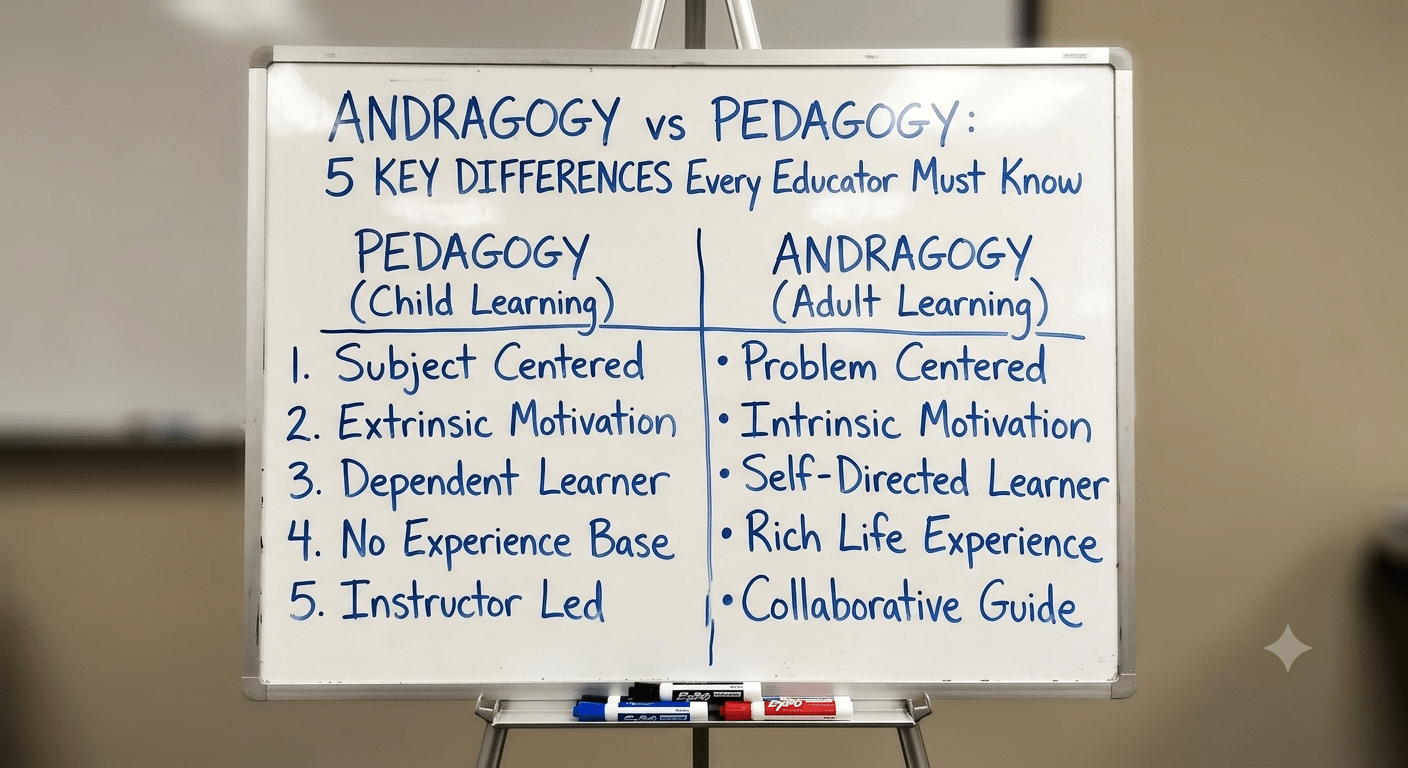
5 Key Differences: Andragogy vs. Pedagogy
The key differences between andragogy vs pedagogy are;
-
Learner Autonomy: Directed vs. Self-Directed
In a traditional classroom, the instructor determines the learning pace, what to teach, how, and when the session ends. On the other hand, andragogy lean towards student autonomy where mature learners are responsible for their educational journey, solve puzzles, and set objectives.
Considering andragogy examples for adult educators, this progress replaces heavy syllabus with well-explained, self-paced learning paths. It ensures that students get to work on practicals and assignments that align with their set goals.
-
Role of Prior Experience: Blank Slate vs. Rich Reservoir
Irrespective of age, pedagogy views students as blank slate that can be molded through the instructor’s knowledge. But a matured candidate’s mind does not work that way because they already have vast personal and professional experiences.
In Malcom Knowles adult learning theory principles summary, adult education must be built on prior background. This would encourage them to easily connect new concepts with past knowledge and better think of solutions that solve immediate problems.
-
Orientation to Learning: Subject-Centered vs. Problem-Centered
Pedagogy teaches concepts using specific discipline. It prefers the subject centered approach where the educator takes the lead and students listen. However, andragogy prefers a problem-centric orientation as individuals learn when content addresses issues around them. It prioritizes real world challenges making candidates learn at their own pace.
When discussing andragogy vs pedagogy in higher education, the traditional model is about cramming academic subject matter while the other deals with using practical case studies and scenarios as techniques for learning.
-
Motivation to Learn: External Rewards vs. Internal Drive
In traditional settings, young learners are driven by diploma, grades, and external praise. In contrast, self-taught models focus on personal growth, career advancement, and immediate feeling of satisfaction for solving a problem.
The distinct difference between both concepts is that when exploring how to apply andragogy in online learning, course design aligns with student autonomy, real life utility, and individual relevance to keep the candidates engaged.
-
Role of the Educator: Authority Figure vs. Learning Facilitator
In pedagogy, educators are authority figures who control the pace, curriculum design, when and how subjects are taught. On the other hand, adult learning positions teachers as guides that support and collaborate with students during class sessions.
When talking about andragogy examples for adult educators, facilitators build knowledge on past experiences. They begin with open dialogue and co-create learning experiences rather than transmit complex information from top-down manner.
Read: The Somatic Student: Unlocking Peak Performance in 2026
Quick Comparison: Andragogy vs Pedagogy
The Malcom Knowles adult learning theory principles summary is about understanding the progressive shift from a unilateral system of teaching to self-direct learning approach. The below is a quick review of how andragogy vs pedagogy in higher education impact educational programs across distinct paradigms;
-
Primary Focus
Pedagogy majors on subject matter where the educator is the center of foundational content and attention. While Andragogy prefers aligning with the learner’s experience. It prioritizes practical solutions, personal relevance, and assimilation at individual pace.
-
Curriculum Origin
The truth is, pedagogical curricula are complex outlines created by academic institutions and driven by certain benchmarks. But andragogy curricula choose collaborative approach to achieve career goals and immediate need.
-
Feedback Loop
In pedagogy, evaluation is from top to bottom. The educator takes the lead, summarizes the course, and assesses what has been taught. However, the other category feedback is continuous and formative. The instructor serves as an active coach while students self assess and peer review.
-
Real-World Application
Pedagogy focuses on cramming information for future use unlike the other that demands real-life application for certainty that students comprehend the subject.
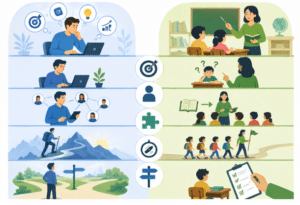
Applying Andragogy in Online Learning: Empower adult learners by incorporating self-directed modules, practical problem-solving tasks, and immediate real-world application into course design.
How to Apply Andragogy in Online Learning Session
Understanding how to apply andragogy in online learning requires creating a flexible virtual environment for students. Rather than the usual boring lectures, educators should structure online sessions based on practical occurrence, group discussions, and self-direct modules.
This way, adult candidates can successfully gain new knowledge and apply their experience to solve immediate challenges. It is all about having an autonomous system with integrated peer feedback loops. By aligning digital courses with internal motivation, every learner gains practical skill mastery over time.
Read: Somatic Resets: Overcoming Complex Learning Gridlocks
Final Thought
When educators understand the psychology behind adult and child learning, it becomes easier to create methodology that ensures impactful educational experiences. Moving forward, know that teacher-led instruction must respect learner autonomy to foster practical application.
This way, andragogy examples for adult educators rightfully transition from being complex to effective facilitators that recognize the foundation of deep engagement, sustained motivation, simplified course design, and practical application.