

Somatic Resets: Overcoming Complex Learning Gridlocks

Share
Introduction
Traditional institute inability to prioritise human absorption limit is the reason for most technical upskilling failures. To put an end to this, corporates must see cognitive load management in training as a vital part of the learning journey. By aligning somatic reset with information delivery, you systematically stabilise your team nerves and maximize data retention.
Read: The Un-AI-able Student: Mastering Biological Agility
Key Takeaways
-
Data Dump Cause Upskilling Failure
The reason for common traditional technical training failure is because instructors ignore their learner’s biological limit thereby causing immediate mental pressure.
-
The Biology of Brain Fog
Experiencing cognitive overload is not due to lack of discipline. It is simply a physiological phase where the prefrontal cortex locks down rendering learning models inefficient.
-
Somatic Resets Solves Mental Gridlock
To resolve issues of mental gridlock, engage in physical regulation such as 1-minute somatic reset. This act maximizes data retention and reopens working memory.
-
Strategic Curriculum Design
Modern institutes must shift from rigid classroom settings to competency-based curriculum design. By breaking down complex concepts into high-impact modules, learning becomes an engaging exercise.
-
Institutional Architecture Audits
To eradicate employee fatigue, reengineer the technical training pipelines to become a resilient workforce. This way, you build a corporate environment that aligns with the right human biology to drive better business output.
The High Cost of Training Gridlocks
When there is information flood without cognitive load management in training, student logic hits a brick wall. This situation immediately causes mental fatigue and employee burnout that results in a decline in certification rates. Aside from the financial toll wasted by corporations because of the existing problem, talent gets lost as operational performance becomes stagnant.
To fix this, you must abandon the traditional approach of protecting educational investment and embrace competency-based curriculum design that considers the learner’s mental state, biological limits, and assimilation level. This way, your employees get transformed to a resilient workforce with sustainable corporate values.
What is Cognitive Load Management in Training?
The process of breaking down complex concepts into something understandable that aligns with the learner’s assimilation capability is known as cognitive load management in training. When a corporation is upskilling, there is bound to be endless data dumps that cause brain friction and mental fog.
This information delivery approach ignores biological processes and expects prompt data storage triggering operational gridlocks. When you know how to stop employee training fatigue, there is always a shift from passive learning environment towards high-retention state.
This academic approach helps arrange data in order of the most difficult ones to ease content digestion while keeping the candidate’s nervous system from entering a ‘fight-or-flight’ mode.
It is an adult learning retention strategy that ensures physical and mental strength align to build foundational knowledge. In the end, your team can clearly process high-stake information and master critical details faster because the technical training respects human mental boundaries. The knowledge gained during this experience is then applied during the work process to improve operational output.
Read: The Regulated Earner: A Framework for Student Success
The Physiological Wall: Preventing Technical Student Burnout
To prevent a situation where the brain hits a physiological wall during technical training, avoid information overload that might cause the prefrontal cortex to lock down.
When you understand how to fix brain fog during the study process, you have time-management skills that focus on achieving the best results. The reason is because real cognitive endurance is not just about studying.
It involves active nervous system regulation for focus that targets intentional stress baseline reset to clear out mental exhaustion. This way, cognitive health is effectively protected while preventing technical student burnout.
Integrating Somatic Regulation Activities for Learning
By creating a workflow that aligns with the candidate’s assimilation capability, you have unlocked adult learning retention strategies. The truth is that trying to force knowledge cognitive unlock when under stress only deep staying in survival mode.
So to achieve a successful classroom session, integrate somatic regulation activities for learning that have a direct impact on instructional architecture. This is how to fix brain fog during studying that does not have to do with the learner’s discipline act but more about human biology.
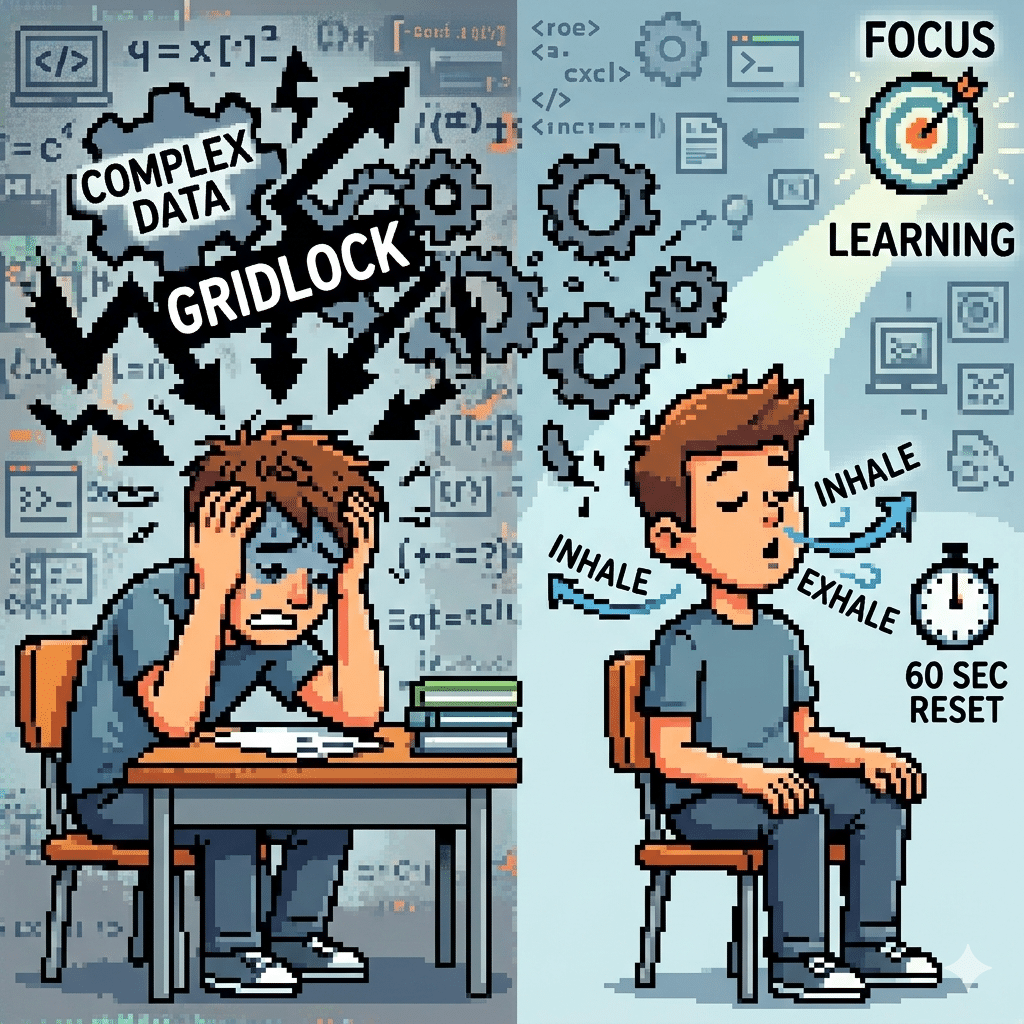
Exercise such as 60-second physiological deep breathing has proven helpful and always signal safety to the brain. It also lowers your heart rate and gets the prefrontal cortex ready for logical reasoning.
At the end, the nervous system regulation for focus gets prepared for high-precision active recall. By ensuring that somatic regulation matches mental effort. And institutions can now produce students with higher mental bandwidth, maximum information retention, and long resilience under pressure.
Shifting to a Competency-Based Curriculum Design
When establishing a competency-based curriculum design, institutes must prioritise classroom sessions that reflect true skill mastery rather than rigid learning. Before now, traditional training models failed because heavy data overwhelm student working memory causing immediate mental exhaustion.
By incorporating cognitive load management in training strategies that organise learning materials that breaks content into high-impact and digestible models, you have created a system that respects human mental boundaries.
This curriculum must depend on student performance rather than completing the syllabus. This way, you can be certain learners have achieved data retention. When you have an education system that follows this structural evolution, you simply protect your academic investment and eliminate any gridlocks. And that might be the answer you need to turn your candidate into a top-regarded professional asset.
Try This Now
The next time you experience brain fog when faced with an overwhelming complex data, try the below 1-minute hack to reset your nervous system performance;
-
Stop Everything for a Moment
Immediately you hit a mental wall, stop the assimilation act and sit up straight while your shoulder drops.
-
Practice Double Inhale
Then, practice a respiratory exercise that involves taking a deep sharp breath followed by a short inhale to expand your lungs.
-
Exhale Slowly
The slow release of inhaled breath through the mouth comes next at this stage. This act should be done twice.
-
Repeat the Entire Process
There is no limit to the number of times you should repeat the entire process. It can be twice, thrice, or four times.
This physical protocol is helpful because it triggers biological signals that tell the brain that it is in a safe zone. Similarly, there is a notable heart rate drop as the stress hormones instantly freed up from the learning gridlock.
Schedule Your Institutional Architecture Audit
How to stop employee training fatigue requires more than just rescheduling your meeting calendars. It involves creating a corporate framework that eradicate technical exhaustion and inefficient upskilling pipelines.
By integrating adult learning retention strategies, you take control of your organization’s intellectual performance by eliminating cognitive gridlocks that might cause burnout. Turninlearning Website have always provided comprehensive guides suits for corporate and educational institutes that ease the process of upskilling your team as they make strategic impact that reflect on your business goals.
People Also Ask(PAA)
-
How do I fix brain fog during study time?
To fix brain fog during intense study sessions, you need to prioritise your nervous system. Instead of focusing on completing the syllabus, pause and initiate a 1-minute somatic reset to relax your heart rate and reopen your mind to more data assimilation.
-
As a corporate guru, can I stop my employee training fatigue?
Yes, it is possible to stop employee training fatigue as a corporate leader. All it requires is to shift from the traditional data-dump learning model to competency-based curriculum design that aligns with your employee biological limit. This strategic move must ensure that your team’s mental bandwidth is protected.
-
Why does the traditional technical learning model fail?
The simple reason for traditional lecture failure is that it does not respect the human mind. When learners are overflooded with information, their biological response freezes which halts data retention.
-
Why are somatic activities important for learning?
Somatic activities are important during study sessions because they signal safety to the brain. Physiological engagement such as 60-second deep breathing has proven to release physical tension and improve student mental information retention.
Conclusion
True mastery requires balance between mental effort and biological state. When the nervous system is stressed, it is impossible to overcome learning gridlock. So next time, create a structured curriculum that ensures information delivery is well broken down to protect cognitive bandwidth and improve retention. This is the only true approach to producing an efficient workforce that serves as an all-round asset.
Stop Training Fatigue Today
Wasting budget on tech training that burns your team out? Eliminate cognitive gridlocks and maximize data retention with our biologically aligned learning frameworks.