Andragogy vs. Pedagogy: How to Fix Adult Learner Lock Up Under Pressure

Share

Introduction
Understanding what andragogy and pedagogy entails is the first step to solving the crisis behind cognitive freeze experienced during exams. By moving past the traditional learning approach and embracing new age academic theory design tailored to human biology, you signal readiness to unlock cognitive resilience under intense pressure.
Read: The Institutional Audit: Fixing Technical Training Curriculum Bottlenecks
Key Takeaways
-
The Cause of Brain Freeze
Sometimes, exam failures are not due to intellectual reasons. It may be a biological mismatch. This is why institutions are advised not to force adults into a learning box that might trigger stress response.
-
Andragogy vs Pedagogy
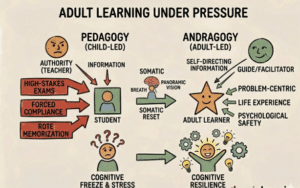
Pedagogy involves the traditional child-centric and rote memorization approach. While adult learning theory such as andragogy is an improved model that ensures matured candidates can assimilate better when information is explained through real life context and autonomy.
-
The Neurobiology of Stress
The neurobiology behind stress is that the brain gets hijacked by amygdala when a student is under mental pressure. This experience limits blood and glucose flow to the prefrontal cortex, the part responsible for logic and decision-making.
-
Somatic Regulation is the Best Solution
Forcing more data input is not the right way to fix cognitive shutdown. The solution is somatic regulation for adult students that involves physical resets that lowers the heart rate and forces the nerves to exit pressure mode.
-
Assimilation Beats Cramming
Cramming is simply inputting data without getting a clear meaning of what it entails. On the other hand, contextual study serves as the ultimate guide for exam preparation because it involves framing your questions around practical scenarios that won’t cause cognitive friction.
The Invisible Wall in Adult Education
Most adult learners experience cognitive shutdown when faced with complex tasks. This mental paralysis happens because learning design is structured to treat students as children ignoring the balance of andragogy vs pedagogy.
While the traditional approach relies on cramming and rigid compliances that causes corporate anxiety, modern adult learning theory proves that real world learning requires mental safety and autonomy to thrive.
This is the best approach to dismantling the invisible wall of academic assimilation. Also, the instructional materials must not only be classroom-centric. It must align and protect the nervous system, shifting from cognitive stress to sustainable endurance.
The Core Divide: Andragogy vs. Pedagogy
To unlock students’ cognitive endurance, the best instructors understand the rudiments that cause friction between how young ones assimilate and how adults learn. The discrepancy is the core of pedagogy and andragogy.

In simple words, the traditional method designed for children’s learning is known as pedagogy. Here, the teacher is the authority figure as the young ones rely heavily on rote memorization, passive lectures and rigid compliance.
While this approach seems effective during the early learning years, it is not sustainable for mature professionals. The reason is that when adults are forced into a compliance learning box, it results in cognitive friction triggering underlying survival instinct.
On the other hand, andragogy remains the cornerstone of modern adult learning theory because the design best fits matured minds. The assimilation model involves real life experience, self-direct approach, and problem-centric application. With andragogy, knowledge is more about how well not how far.
The main reason for adult education systematic failure is because institutions utilize pedagogical approach for andragogical minds. Due to this mismatch, learners experience performance anxiety making the adult mind perceive a simple test as a threat.
If modern curriculums could encompass somatic regulation for adult students, mature learners will progress better academically. The incorporated model should have a framework that aligns with the student’s nerves. So, the prefrontal cortex activity does not affect spiking the heart rate during the classroom session.
The Science Behind How Stress Blocks the Brain
During exams or intense executive engagement, the brain shuts down due to the fact that there are neurobiological irregularities. The body alarm system known as amygdala gets activated from the adrenaline and cortisol surge.
This mechanism then causes the reduction of glucose and blood flow to the prefrontal cortex, the part of the body responsible for logic and memory recall. This physiological hijack can also be used to explain the clear differences between andragogy vs pedagogy.
While the former relies heavily on the traditional ways of doing things such as; high stake test that led to adrenaline spike, pedagogy prefers modern adult learning theory best suited for matured minds.
It is proof that anyone can assimilate complex data as long as the necessary biological and psychological requirements are met. When under intense pressure, the truth remains that your stored data isn’t missing.
It is only your nervous system that barricades the path to retrieval. For this not to repeat itself, adult learning models must include physical tools that immediately regulate the body when it sense threat. This way, the brain stays clear and ready to analyze any information.
Try This Now
The moment you notice a spike in heart rate or forgetfulness while studying, know that your nervous system is shifting to a panic state. When this happens, the next step is not to force assimilation. Instead, adopt a somatic framework designed to regulate your stress baseline and reopen the nerve pathways. Here is how to go about it;
-
Regulating your Heart Rate
A spike in heart rate will always inhibit learning. So, take a sharp, deep breath to expand your lungs and slowly let out the exhale through your mouth. Repeat this twice and you will notice a gradual collapse in your stress level. This rapid response forces carbon dioxide out of your bloodstream.
-
Peripheral Vision Shift
Most times, when the brain is stressed, it makes you focus gaze on a particular object or material. To de-activate, simply soften your eyes. Ensure that your vision scope expands beyond the text material without moving your head. By holding a panoramic view for at least 15 seconds, the automatic nerve ‘fight-or-flight’ response gets kicked out and brings calmness to the body.
-
Re-engage Andragogy
Now that your body is calm, focus more on key aspects of the learning material. Instead of asking “Effect of climate change on human geography?”, twist the question to something related to “How does weather change affect real-life scenarios that I have experienced before?”
By following the above guide, you are using your past experiences to break down concepts without moments of friction. It is an excellent approach to training your biology to see academic sessions as a period to become a better candidate.
Why Andragogical Approach is the Best for Exam Preparation
Andragogy is regarded as the ultimate strategy to examination preparation because it honors the fundamentals of adult learning theory. Unlike pedagogy that focuses on memorization and passive training approaches that lead to mental stress, andragogical framework sees active learning as prioritizing self direct problem-solving processes.
It is all about putting the student’s mental capability first before the exercise begins. When evaluating differences between pedagogy vs andragogy, matured professionals prefer the one that makes assimilation easier for adults because it anchors information on existing real-life expertise.
Rather than a textbook approach that forces compliance. The andragogy model ensures that students remain calm, analytical and capable of information recall during a deep comprehension process.
Nerve Regulation: The Strategic Fix
When one experiences a mental freeze during an exam, the best solution is nervous system regulation. While most traditional approaches ignore the effect of biology on how adults learn, resulting in brain fog when more data is forced in, the modern approach does not work that way.
It ensures that when somatic regulation for adult students are implemented, there is a biological override over pending mental lockdown. Deploying physiological resets such as; 6o-seconds nerve engagement has proven to shift learner’s vision to regulate threat response. At this stage, one notice lower heart rate and calm state before the nerve pathways opens for memory retrieval.
Read: The 2026 Skill Pivot: Why Metacognition is the Most Important Adult Learning Skill in the AI Era
Conclusion
The secret to conquering adult learner cognitive lockdown requires a fundamental shift in the instructional model. By understanding the rudiments of andragogy vs pedagogy, it becomes easier to transition from an exhausting child-centric academic environment to a modern safe space that aligns with adult learning theory. True knowledge is not by how much you can cram. It involves mastering your profession without pushing your nerves into a survival state.
Discover the key differences between andragogy vs. pedagogy and learn proven strategies to help adult learners overcome learning lock-up under pressure. Read the guide now and transform your teaching results.