

How to Teach a 4-Year-Old to Read at Home

Share
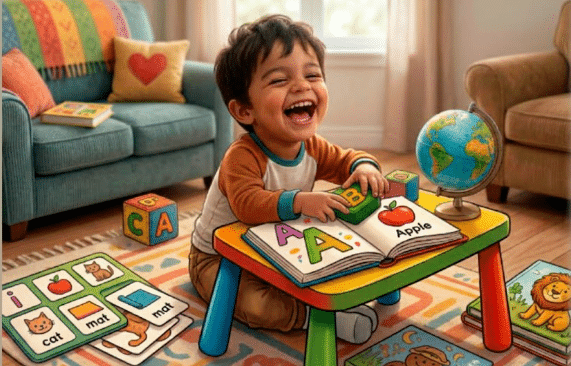
Teaching your 4-year old how to read at home is not an herculean task. All it requires is focusing on their early literacy skills and unlocking the power of phonics for kids. Since the learner is still young, you can incorporate daily playful adventure routines that build their confidence and improve letter sounds.
Key Takeaways
-
Shift the Four-year old Mindset
For young learners, reading should be treated as an empowerment scheme where adults incorporate foundational concepts into daily routine rather than a boring duty.
-
Ditch the Usual “ABC Song”
Rhythms are good but not known as the best comprehension approach. To prioritise phonics for kids, teach the actual letter sound not just the names so your child can decode and blend words independently.
-
Adopt Play-Based Learning
As a parent, your everyday activities such as; grocery shopping, cooking, or handling chores must be structured to encompass your four-year old early literacy skills without them being in a rigid learning box.
-
Mix Phonics with Sight Words
Establish a phonetic foundation at home where highly recognised sight words for kindergarten such as said, was, the, and like are frequently used.
-
Normalise your Four-year Old Engaging Environmental Print
For every print out words on the streets, toys or cereal box, allow your kid to practice reading them to improve their real world skill.
Read: The 2026 Micro-Mastery Protocol: How to Build a Human-AI Study Architecture
See Reading as an Empowering Habit for the Four-year Old
For a kid, learning should be about unlocking potential and reading shouldn’t be seen as an academic duty. By adopting this model, you have simplified abstract symbols of curiosity into meaning landscapes that ensure confidence.
You can start with creating a structured framework like phonics for kids that provides children with tools to be able to decipher and navigate unfamiliar words independently. This way, you have laid a foundational knowledge for sharp sight words for kindergarten as your child reading fluency improves over time.
When you adopt this rewarding routine, you also build a mind with psychological resilience mastery capable of attempting complex challenges far beyond tender age. Fostering a reading culture from a cradle has proven to help prepare a child not just for school but to become an active thinker ready to explore the real-world.
The Power of 4-Years Old Play-Based Learning Approach
At age four, playing is not just an avenue to pass time, it is a primary way to sense the world. As a parent or class instructor, you can leverage this by a structured play-based learning approach that dwells on the underage curiosity. This way, you have turned their everyday routine into brain building moments.
When you involve a child in imaginative scenarios that actively develop their cognitive framework. They aren’t just having fun, you are strengthening their early literacy skills by connecting sounds to letters or symbols without pressure.
For instance, create a make-believe shop or listen to stories as a group activity. You will notice that the child(ren) oral skills improve as they can identify sounds, letters, or symbols without going through the traditional learning box.
Just as adult assimilation requires building on existing knowledge, a four-year old comprehension focuses on play to build emotional resilience and social cooperation skills. This way, you have laid a solid educational foundation that supersedes routine cramming.
Forget Alphabet Songs, Prioritize Your Kid’s Phonics
To unlock your 4-year old reading at home ability, I would suggest ditching the traditional alphabet songs. Though it might appear counterproductive, numerous studies have shown that prioritizing phonics is the fastest way to improve your child’s oral skills.
This is because the usual “A-B-C rhythm” is designed to teach letter names not the actual sounds they make. So to avoid a situation where your child knows “A” but not “Apee”, focus more on phonics for kids.
By doing this, you have bridged the existing gap between letters and sounds. As your kid can easily blend sounds together to decode words independently. The only thing you have to do is establish a solid phonetic foundation after which sight words for kindergarten such as; “of” and “the” follows.
Then, you can be sure to have transformed reading from a frustrating exercise into an empowerment mechanism that can be practiced anywhere at home.
Build Confidence with Kindergarten Sight Words
Building your 4-year old confidence at home through kindergarten sight words is not an herculean task. Just adopt a play-based learning approach where your kids go through the high-frequency academic process like a game rather than chore.
Then, it becomes easier for them to recognise essential words on sight and eliminate those that might sound phonetically frustrating such as “said” or “was”. By doing this, you have successfully turned the learning session into an interactive challenge where your kid’s early literacy skills get accelerated.
Similarly, you have bridged the gap between the young learner recognising individual letters and improving reading fluidity. Gradually, your 4-year old will realise that they can read fluently through their favorite storybooks without experiencing anxiety. This success tends to build their confidence and transform them from a novice to an enthusiast ready to explore the world of books.
Read: How Does Somatic Regulation Help Your Age 12 Child’s Tantrums?
Incorporate Learning without Formal Study Time
Setting up a formal study time at home can be regarded as a rigid approach to learning. Instead, integrate what you intend to teach into the4-year old daily routine. This way, it is easier for them to comprehend foundational concepts naturally without appearing like they were forced to study.
By embracing a play-based learning approach, everyday routine becomes an interactive and exciting classroom activity. From cooking in the kitchen, to game sessions, or bedtime. Your kid gets an opportunity to learn a word and decode adventures without much work.
This seamless integration is regarded crucial for early literacy skills because as the 4-year old progresses, they do not get the feeling of being put on the spot. As their daily life is filled with alphabet matching and environmental prints that would make their language acquisition appear organic, stress-free, and joyous.
Conclusion
To successfully teach a four-year old how to read at home, you need to create an environment that ensures balance and patience. This way, they can gradually decode new sight words for kindergarten without much struggle. Just keep the learning journey joyful and you will notice that your four-year old can have genuine love for books despite being at a tender age.
Ditch the rigid flashcards and discover how to build your child’s confidence naturally through engaging, play-based strategies.
Read How to Teach a 4-Year-Old to Read at Home to unlock essential phonics secrets and accelerate early literacy skills today!