
Resilience Activities for Stressed Students: Somatic & Mental Tools

Share
The era of digital saturation and much academic pressure has put students in a state of high alertness. This mental exhaustion is not just a pandemic but has prompted top educationists to call for intentional steps that would help learners rebuild their psychological and physiological confidence without having any effect on their grade.
The strategies outlined below highlight effective resilience activities for stressed students: somatic & mental tools are well embedded in this writeup. Note this engagement do not just rejig your mind but also help regulate your sensory cells while improving one’s Social-Emotional Learning (SEL) creativity.
What are somatic resilience activities?
Somatic resilience activities are body-centered techniques—such as vagus nerve stimulation, rhythmic breathing, and sensory regulation—that lower stress levels by shifting the nervous system from a state of high alertness back into cognitive balance.
Before continuing, please note that if you make a purchase or sign up through link on this post, we may earn a small commission at no extra cost to you.
Partaking in the about to mention mental clarity act is an excellent approach that could help you multitask better without experiencing sporadic burnout. Some of these top extracurricular pursuits include;
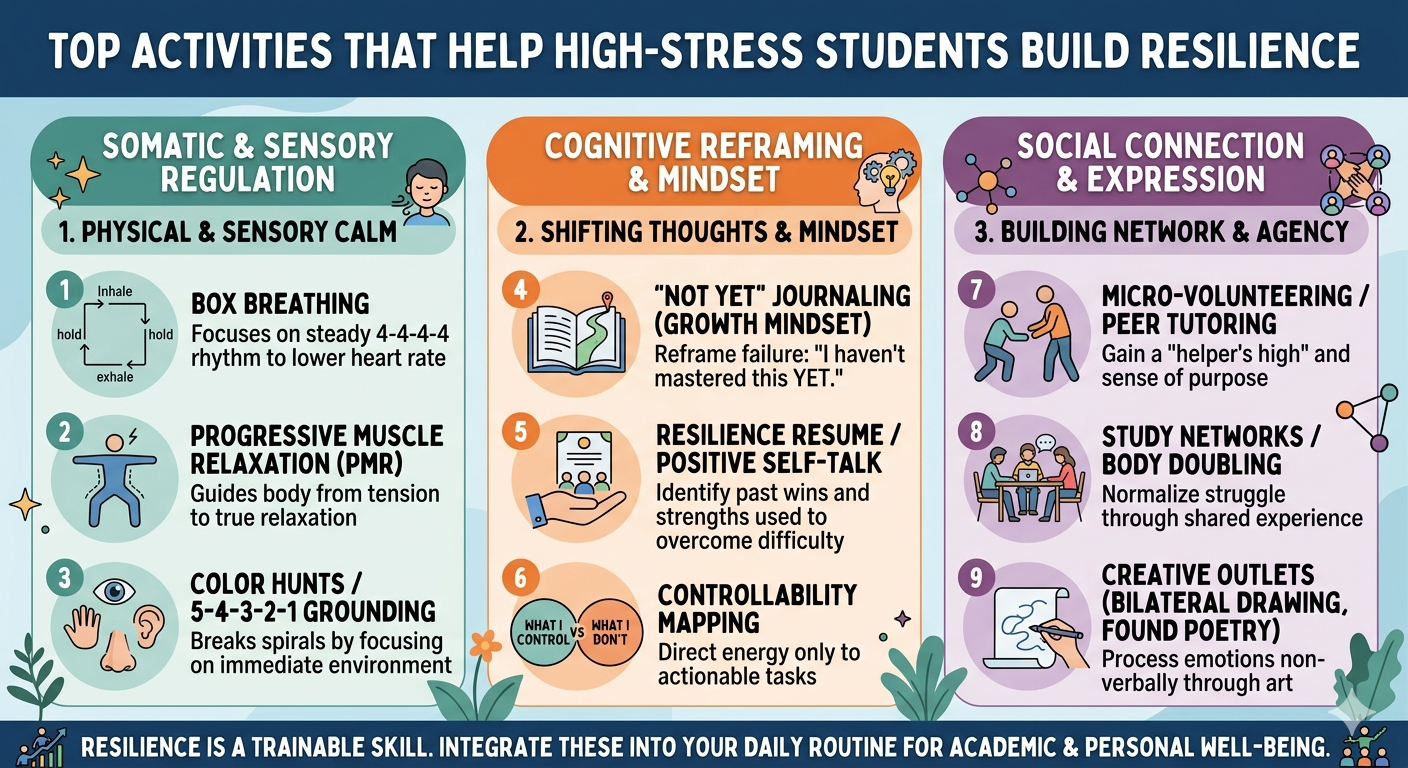
Somatic & Sensory Regulation Exercises
True relaxation under high stress does not have to require much work and can easily be practiced in small spaces to encourage nervous system recovery. The most important is to achieve a state of moderate physiological mind state.
As a beginner, a simple rhythm of breathing for 4 seconds can help stimulate your vagus nerve to lower the heart rate. Just as the butterfly hug workout which involves arm crossing over chest and light tap over each shoulder helps stimulate overwhelmed emotion.
These growth mindset activities and more have proven effective for top graduate students and come at zero cost. You only need to be creative about what you choose and gradually you experience positive cognitive balance. As an undergraduate, try the short exercise for a month and you will notice great improvement in your social-emotional learning (SEL) skills in no time.
Cognitive Reframing for Academic Stress
Unlike the earlier mentioned tip, mind reframing is more psychological than physical. It requires an attentive cognitive approach to achieve necessary cognitive goals. A simple way to understand what this means is that progressive thinking implies how you interpret challenges.
Most people don’t know that when in a difficult position, how you manage the situation could determine your stress level. An excellent approach I would recommend is taking a short rest while remaining positive-minded or optimistic.
This way, you give yourself time to think and strategise on the next step to take. Individuals with cognitive balance are usually well sorted after by top entrepreneurs. Try it today and experience significant change in your stress level.
Cognitive reframing becomes easier when your brain isn’t carrying dozens of scattered deadlines. Instead of keeping project roadmaps in your head, centralize study architecture into a unified AI workspace like Taskade. By using an efficient AI workflow generator, you simplify overwhelming research projects or quiz into bite-sized, automated task lists, reducing mental anxiety and restoring cognitive clarity.
Read: AI Metacognitive Study System: 2026 Guide to Fast Learning
Social-Emotional Connection (SEL) for Isolation
As a student, it is important to know that excessive isolation often leads to burnout. This is why building social connections helps you regulate your mind when necessary. Know that, you do not have to be an extrovert to achieve your tech boundary setting objective.
You only need to find genuine people to build connections with and try to engage them whenever you want to rejig your mind. It works like magic and has worked well for top students doing well in their individual field across different niches.
If you are a shy person, start by helping your peers with simple tasks such as assignments. Gradually, you can shift to tutoring for a few minutes then gravitate towards having a solid network with them. With time, you will notice a significant reduction in your sense of emotional spike as your sense of purpose begins to improve.
If organizing group study sessions feels tiring, lower the social friction by building a shared digital workspace. By using Taskade’s collaborative AI spaces, you and your study partners can brainstorm ideas, track group assignments, and chat in real-time within a single dashboard. This tool helps keep everyone accountable without unnecessary stress.
Disrupting Negative Physiological & Habit Loops
There is a common saying that your habit defines you as a person. I tend to agree with this notion because little things matter and we are all embodiment of our daily act. This is why it is very important to be intentional about what you do or consume.
If you want to build your social-emotional learning (SEL) skills, try to cut what you perceive could disrupt your psychological pattern. It may be an eating or drinking habit, but whatever you think might have a long-term effect on your general well-being, see it as bad behavior and be intentional about adopting positive change.
Build a strong positive identity
Your identity is simply how people see you. It is the kind of person those around you perceive you to be. While people’s perspectives are prone to change, you can build a strong positive identity by changing the narrative of your history.
To begin, start with jotting down difficulties in your experience before accomplishing a task. Narrate how you feel and process utilised to overcome the hurdle. This way, you gradually change your mindset from “fearful” to being “optimistic”.
Read: AI Study Architecture: How to Learn Faster in 2026
You see problems as casual challenges that can be solved with the right growth mindset activities and tools. And gradually you build resilience as a tertiary education student. Similarly, you can decide to give your stress or current challenge a name. Doing this, reduces unwanted emotional overwhelm and helps create a safe distance between your identity and current temporary feelings.
Final Verdict
Your ability to manage stress and navigate through it without succumbing to burnout is what building student resilience is about. It does not necessarily have to do with physical engagement; cognitive reframing and intentional social connection among others are excellent approaches for you to transform overwhelming emotion to relief. The most important is ensuring that your brain does not see the challenge as insurmountable rather a temporary hurdle that can be solved with the right sustainable habit.
Stop letting disorganized assignments drive academic burnout.
Choose Taskade as your all-in-one personal cognitive sparring partner today. Talk about organising your study schedules, generate automated outline frameworks, and manage daily cognitive load, the tool got you covered with built-in AI micro-task generators.