The Ghost-Worker Trap: Why AI is Making You Invisible

Share
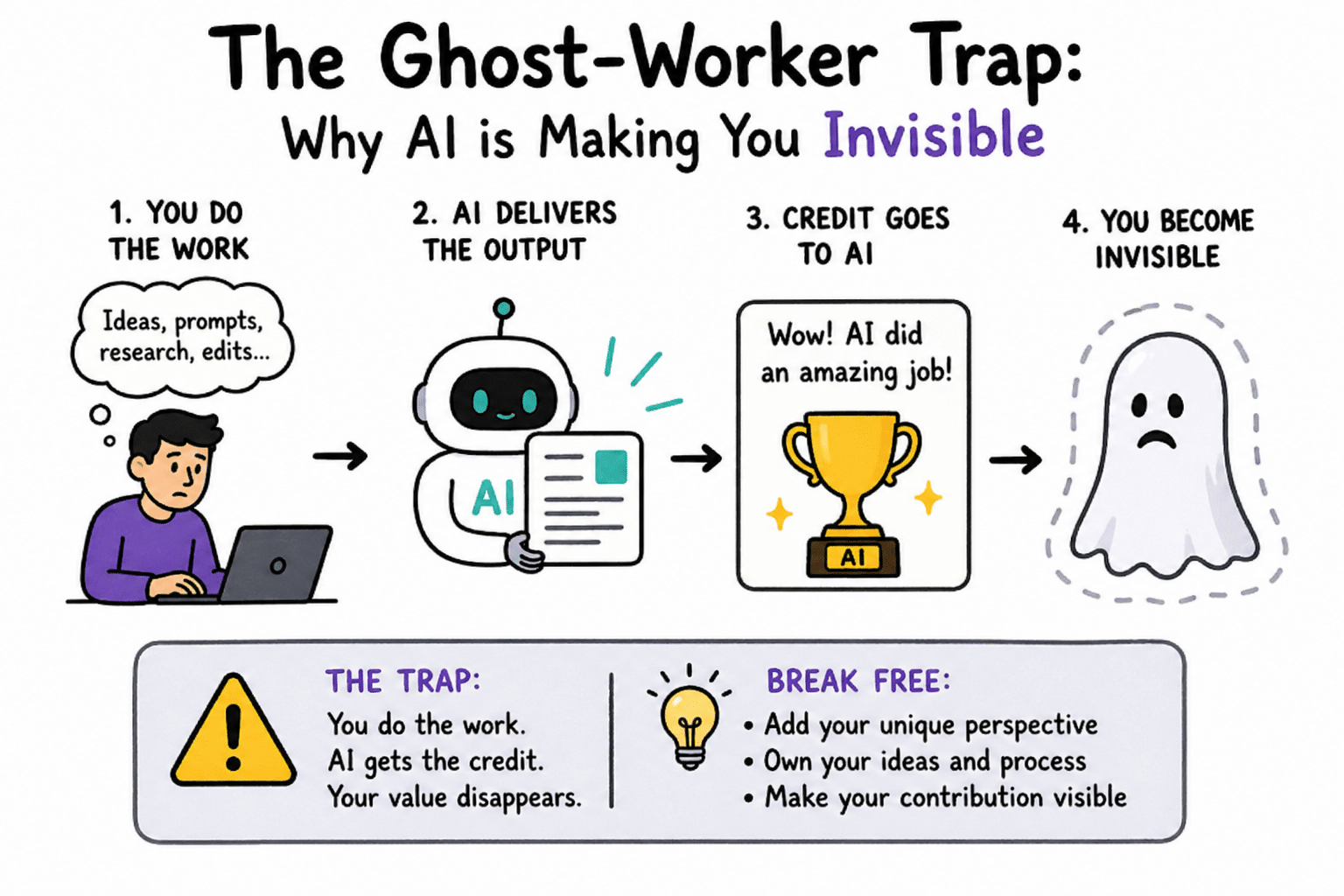
Following the idea that the 2026 AI economy is here to optimize daily operational processes, thousands have fallen into the Ghost-worker trap. A phase whereby professional output lacks human signature making you invisible to potential employers. To survive, there is a need for proof of thought– a verifiable record that encompasses intuitions that software cannot match.
The Ghost Worker Rise 2026
The ghost-worker rise 2026 can be described as a systematic crisis that involves professionals being invisible due to AI utilization. As the increase in automation continues, many have fallen into a state where their output is technically correct but lacks the adequate human cognitive signature that makes it appear top-notch.
It is simply a direct reflection of AI-powered learning failure as the architect uses shallow prompts to bypass the friction of deep study. Whatever results obtained at this end are usually hollow, meaning the machine can easily replicate them.
To experience change, the 2026 workforce must prioritize proof of thought. The reason is that a human touch is a final and verifiable trail that involves strategic synthesis, intuition, and ethical pivots adopted during the process of breaking down the concept. So, whenever your work appears perforated, know that the easiest way to displace excellence is to reduce automated noise and escape the cycle of repetitiveness.
Read: Beyond the Prompt: How to Build an AI-Powered Metacognitive Study System in 2026
Why AI-Powered Learning is Failing Your Career
The true reason why AI-powered learning is failing your career is that it removes the process of struggling to get the best output. When you prompt AI to break down a complex topic, the first answer it provides is usually generic.
So, to bypass the deep encoding process, adopt human intuition. Without this hollow skill set, a high-level layer of knowledge meant to help you survive the intensity of a corporate cognitive stress test, 2026 recruiters might classify you as an intellectual liability to the workforce. The hiring processes have changed as employers are now trained to identify semantic friction that comes from only intellectual labor.
An excellent approach to be competitive in the labor market is having a semantic architecture. This way, you have already mapped out the entire field of the complex concept even before the first keyword is typed.
It is an excellent approach to moving from being a regular prompt operator to being an active strategist. At first, the entire process might be rigorous. But gradually, you earn an Un-AI-able credential that is a viable signal that you don’t have surface learning experience but possess critical judgments that eradicate algorithmic repetition. The foundational depth to career progress is being the mind of everything that has to do with your work process in the increasingly automated world.
The “Proof of Thought” Fix
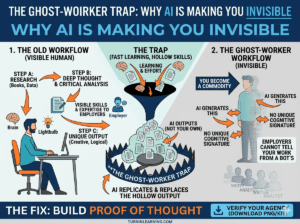
To avoid professional identity erosion, the proof of thought fix helps serve as your defence mechanism. Here is how it works; following the increase in ghost-worker traps in 2026, more contents tends to appear perfect on surface-level but lacks biological emptiness.
This hallmark is described as AI-powered learning failure; a state where one just tasks intelligence to do their job while omitting intellectual synthesis. To solve this menace, you must transition to a strategic thinker by documenting your entire reasoning process.
Every single step must be jotted down for reflection and future reference. The proof of thought also described as a cognitive ledger is built through the below-specific actions;
-
The Semantic Study Ritual: This is the first step where you manually map the complex concepts to establish a cognitive anchor. It serves as a guide to engage the AI.
-
The Refusal Log: Here, histories of where you rejected an AI’s suggestion, correct a notion, or restrategize a prompt to get better results are found. Note that these previous results are based on somatic intuition.
-
Synthesis Authority: The final act is the human touch that involves weaving AI outputs to identify and expunge information that does not correlate with your unique perspective.
By going through the above-mentioned process, you have solved your decision-making credential crisis. The results provided are not just final deliverables, they are evidence of strategic thinking aimed to provide high-impact value that secures your position as a credible and well-knowledgeable leader. It makes you difficult to replace in the competitive 2026 job market.
Read: AI-Powered Micro-Upskilling: The 15-Minute Roadmap for Career Transition in 2026
The Escape: Building an Agentic Portfolio
Escaping the ghost-worker trap is to become a dynamic portfolio architect; a shift from basing competence on past roles to being an active thinker. The reason is that recruiters now see regular CVs as a hollow skill set because it does not prove that you are the brain behind the heavy lifting.
To counter this claim, your resume must show semantic architecture- a document that shows the logical processes involved in accomplishing a specific goal. It is also the first principle that directs the software approach.
When you position yourself strategically in the labor market, you pass the recruiter’s cognitive stress test meant to separate those that “prompt AI” from the actual “thinkers”.
The semantic architecture also contains past verifiable evidence of your manual override, making strategic decisions, and prompt iteration; it is enough evidence that you can transform a workflow into Un-AI-able credentials. As long as your intent remains aligned with the navigation of solving the complex subject, you have a competitive edge to scale the professional ladder faster.
Conclusion
The easiest way to escape the ghost-worker trap is to prioritize quality over quantity. You must shift focus from output volume to cognitive-driven results. When you rely on automated, summary provided by the software are categorized as AI-powered learning failure.
And it is a fact that such output could lead to professional invisibility irrespective of the standard of your CV. So, secure your future today by documenting every strategic decision that synthesises with AI utilisation to get results that cannot be replicated in the ever changing digital era.