AI Technical Study Guide: Master Hard Topics in 15 Mins

Share
The challenge in the AI era is not finding information but surviving the digital distractions that come with it. This is why modern adult learning strategies 2026 teach techniques to bypass the current information tsunami.
By leveraging the below 15-minute ritual cognitive load theory, your artificial intelligence tool serves as a way to pre-analyse data in order to focus on the result mastery. You simply stay away from diversions by using modern frameworks to transform complex subjects into high-impact insights.
Read: The “Human-AI Hybrid” Skillset: How to Use AI for Personalized Micro-Upskilling
What is a Semantic Study Ritual?
A semantic study ritual is an AI-assisted learning workflow where complex technical concepts are broken down into underlying logic (semantics) using 15-minute study sprints. This method prevents mental freezing by focusing on cognitive models and active recall rather than passive rote memorization.
What exactly is Information Tsunami 2026?
Information tsunami 2026 implies the digital landscape being transformed into a flood of data whereby finding accurate insight leads to mental paralysis or burnout. For years, the increase in volume of content in the digital space has made learning processes quite stressful, making experts describe it as a high-beta state.
To survive this, modern learners have to adopt somatic regulation for focus approach which requires using one’s immediate environment to trigger parasympathetic activation before touching the keyboard.
Here, your nervous system becomes well-regulated as you build the necessary student resilience required to handle the forthcoming challenge. You also gain a competitive edge by preparing yourself for the 15-minute semantic study ritual.
To effectively manage time, utilizing AI for personalized micro-upskilling helps reduce drowning in computer tabs. Just as precision prompt engineering filters noise and acts as a cognitive distiller for actionable and first-principle insights. The end game to this approach is that your tool is not a barrier to mental peace but a bridge to smooth mastery.
Somatic Grounding: Priming the ‘Learning Brain’
Attaining deep learning mastery requires first addressing the learner’s biological state. Somatic grounding for instance is an approach that stabilizes your nervous system from the state of ‘fight-or-flight’ to ‘digital-learning’ mode.
In 2026 where the digital space is filled with so much data, grounding acts as an override for preventing cognitive stress. So by engaging in physical exercise such as lowering the cortisol levels today, your neurons get trained for long-term retention.
Once your physiological state is primed, the next involves utilizing a micro-upskilling roadmap to navigate complex bursts. The earlier biological readiness has enabled you to better use skill gap analysis tools to identify areas to learn without much emotional weight or feeling behind.
The most important is equipping your mind on how to better organize new data into logical Article schema hierarchy as outlined by the search engine structure. By doing this, your mental storage becomes a well-indexed database filled with relevant information.
Gradually, you can then build sustainable lifelong learning habits filled with numerous opportunities. The synergy between a structured mind and a calm body is that for every minute spent learning new insight, it contributes to your scalable expertise.
Can the Prompt-to-Schema Method Work for Complex Subject Mastery?
Yes, it can. The reason is that prompt-to-schema method deeply explains the synergy between machine and human cognition. In adult learning strategies 2026, this approach is more than just engaging AI. It involves using the right wording to transform raw data into digital and structural results. By directing the intelligence to refine its output information into a defined format mirroring article schema, you essentially create a roadmap well explained for the brain to understand without any cognitive load theory hurdle.
It is different from the regular AI prompting. So before your first interaction, put yourself through somatic regulation for focus to improve biological and mental awareness. You can start with a few minute ground exercise involving the prefrontal cortex.
The aim here is to be ready for complex work in order not to experience digital distraction common with the hyper-connected era. Achieving student resilience during this process allows you to better interrogate the AI as a peer rather than a passive recipient.
From another angle, prompt-to-schema method helps improve technical website growth. You only need to structure the learning outcomes to be schema-ready and the data are ported into insights well-recognised on a platform built on managed wordpress hosting.
Note that a vital aspect to this achievement is speed. By transitioning to schema-indexed posts, you will notice technical friction reduction on the high site speed for learners. At the end, the technical optimization ensures that your personal learning curve remains responsive and insightful.
The entirety of this process is to treat raw data as an asset rather than regular text. It ensures that every AI engagement leads to impactful, well-structured and easy to assimilate results. Some regard prompt-to-schema as a clear path for 2026 professional mastery in an era of overwhelming data.
The 15-Minute Implementation Sprint
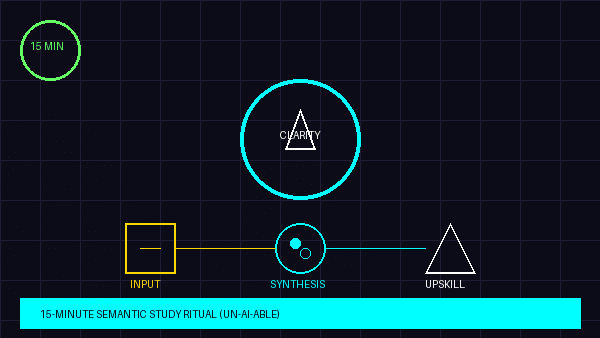
To transform theoretical data into professional assets, adopt the below 15-minute implementation sprint. The world has changed to a fast-paced marketplace. To avoid information delay, there is a need for cognitive agility that dissects high-value concepts. The ritual to achieving this is the below three phases;
Phase 1: The Cognitive & Biological Reset (1-5 Minutes)
This phase involves clearing your cognitive clutter before interacting with any learning material. The objective is to achieve parasympathetic activation that ensures that your brain is in a calm state for knowledge receptiveness.
During the first 2 minutes, perform box breathing and spend the remaining 3 writing down what you previously know about the topic you want to study. This act primes your neural pathways for new information assimilation.
Phase 2: The Semantic Extraction(6-10 Minutes)
At this stage, you use AI for personalized micro-upskilling. The aim is to avoid cognitive load theory pitfalls and extract the main points from the subject for easy focus. To begin, use specialized prompt engineering commands to identify the first key principle of the topic. The question intended for the AI can be: “Identify the 5 concepts of [topic] and explain them using the Feynman Technique”. You will see that the outcomes are structured data defined into an article schema hierarchy.
Phase 3: Metacognitive Synthesis(11-15 Minutes)
The final minutes are for extraction and memory retention. You simply build student resilience by assimilating the AI output. To ease this process, perform a reverse-teaching technique involving questioning the concepts to test your understanding. The AI will then provide feedback based on your explanation solidifying semantic connections in your mind.
At the end of this program, you have not only learnt something tangible but rejig your physical body into a technical structured ready for metacognitive mastery through a high-impact 15-minute semantic study ritual.
Read: The 2026 Skill Pivot: Why Metacognition is the Most Important Adult Learning Skill in the AI Era
Final Thoughts: Building Long-Term Technical Retention
By taking your learning experience to the next level, your brain remains receptive and focuses as the parasympathetic activation helps transform overwhelming chores into insightful processes. The above-explained entire framework is designed to help you become 2026 master of complex subjects with long-term retention
Signup on TurninLearning Website today and access exclusive AI-powered micro-upskilling educational blueprints designed to help you stay ahead always. Own your growth, Optimize your brain.